
Condition Guide
Understanding BPPV
Benign Paroxysmal Positional Vertigo is the most common vestibular disorder — and one of the most successfully treated. Learn what it is, why it happens, and how Dr. Sachan can resolve it.
🌀 What is BPPV?
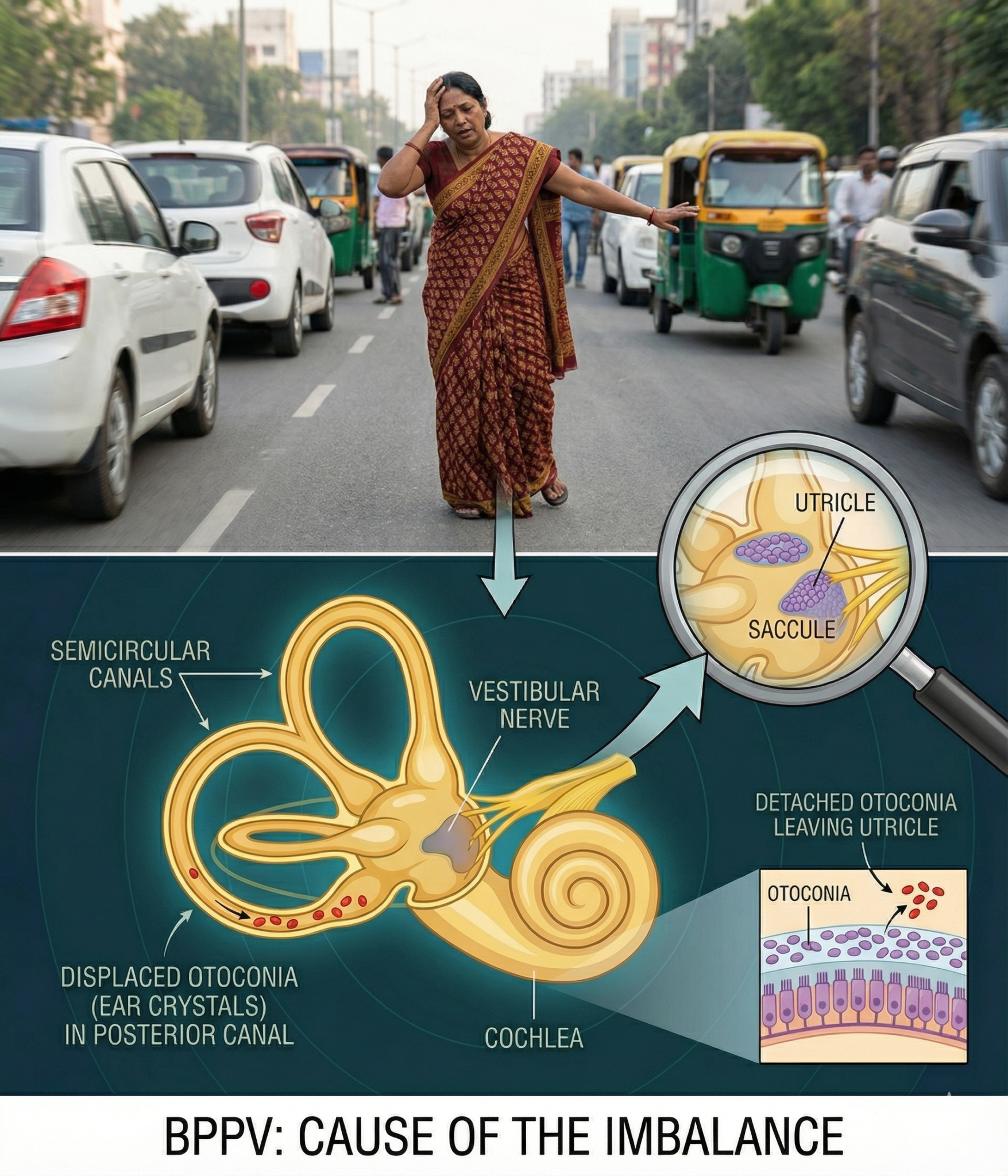
BPPV occurs when tiny calcium carbonate crystals (otoconia) — which normally reside in the utricle of the inner ear — become dislodged and migrate into one of the three semicircular canals.
When the head moves, these misplaced crystals create abnormal fluid movement in the canals, sending false signals to the brain that produce an intense spinning sensation — usually lasting under 60 seconds per episode.
⚠️ Common Symptoms
- Brief, intense spinning when rolling over in bed
- Vertigo when tilting the head up or down
- Dizziness triggered by looking up at a shelf
- Nausea during or after positional changes
- Unsteadiness and fear of falling
- Episodes lasting 30–60 seconds then resolving
- Symptoms that worsen over days and plateau
🔍 Who Gets BPPV?
- Most common in adults over 50 years of age
- Women are more frequently affected than men
- After head trauma or prolonged bed rest
- Associated with osteoporosis and calcium deficiency
- Can occur after inner ear infections
- Sometimes idiopathic — with no identifiable cause
- Recurrence rate of approximately 15–50% per year
✅ Why Seek Treatment?
- BPPV rarely resolves on its own within a reasonable timeframe
- Untreated BPPV significantly raises fall risk, especially in elderly patients
- Repositioning maneuvers are safe, non-invasive and highly effective
- Over 95% of cases resolved with 1–3 clinic sessions
- Treatment is drug-free with no side effects
- Early intervention prevents anxiety and depression from chronic dizziness
- Quality of life improvements are immediate and lasting
The Treatment
The Epley Repositioning Maneuver
The gold-standard, evidence-based procedure for posterior canal BPPV — performed safely in our clinic by Dr. Pratistha Sachan.
Step 01
Dix-Hallpike Test
The patient sits upright on the examination table. The doctor determines which canal and which ear is affected by performing the diagnostic Dix-Hallpike test.
Step 02
Head Rotation — Affected Side
The patient is quickly moved to a supine (lying down) position with the head turned 45° toward the affected ear, held for 30–60 seconds until nystagmus resolves.
Step 03
Head Rotation — Opposite Side
The head is rotated 90° to the opposite side. The otoconia move further through the canal toward the exit point. Held again for 30–60 seconds.
Step 04
Return to Sitting
The patient rolls onto their side and then carefully returns to a seated, upright position. The otoconia have now been guided back into the utricle, resolving the BPPV.
- Canal Variants
Types of BPPV
Most Common · 85%
Posterior Canal BPPV
Crystals in the posterior semicircular canal. Triggers vertigo when lying down or sitting up. Treated with the Epley or Semont maneuver with excellent outcomes.
Less Common · 10%
Horizontal Canal BPPV
Crystals in the horizontal canal. Triggers vertigo when rolling side to side in bed. Treated with the Barbecue Roll (Log Roll) or Gufoni maneuver.
Rare · <5%
Anterior Canal BPPV
Crystals in the anterior canal. The rarest variant, requiring careful differential diagnosis. Treated with modified versions of the standard repositioning maneuvers.
Important Note for Patients
The Epley maneuver should only be performed by a trained healthcare professional who has confirmed your BPPV diagnosis. The canal variant and affected side must be correctly identified first — an incorrectly performed maneuver may worsen symptoms. Do not attempt this at home without professional guidance.